Gldyql The Emerging Framework Quietly Redefining Strategic Execution
It began with a founder who couldn’t explain why his company was busybut not progressing. His team shipped features, ran campaigns, attended meetings, and tracked dozens of metrics. On paper, everything looked active. Yet quarter after quarter, growth remained flat. During a strategy offsite, someone scribbled a strange word on a whiteboard: gldyql. No one in the room had heard it before, but the conversation that followed would reshape how they operated.
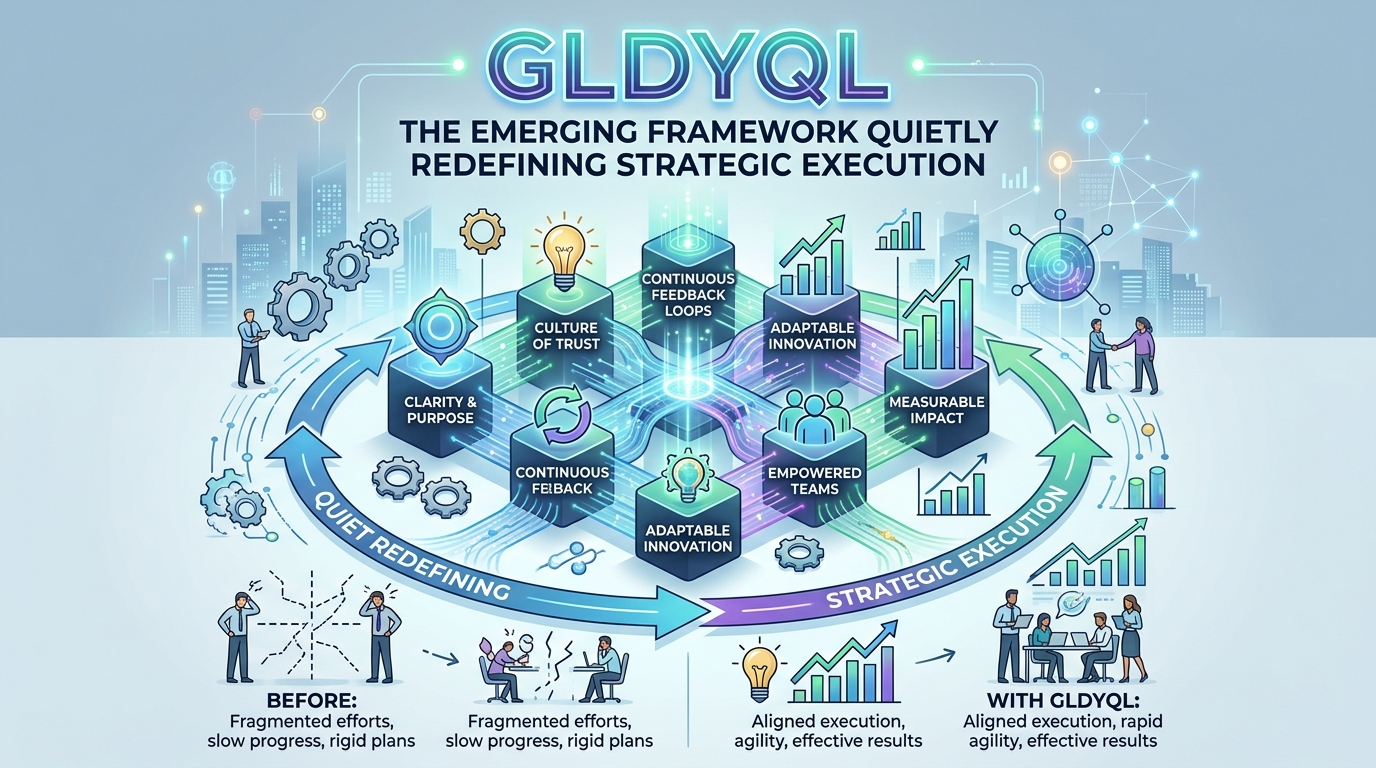
What started as a placeholder term became a powerful lens. Over time, gldyql evolved into a structured way of thinking about execution—one that prioritized alignment, clarity, and measurable impact over sheer activity. Today, it’s gaining traction among entrepreneurs, tech leaders, and founders who are searching for a more disciplined approach to building and scaling.
What Is Gldyql?
At its core, gldyql is a strategic execution framework built around one central idea: alignment drives efficiency, and efficiency drives meaningful growth. While many organizations focus on setting ambitious goals, gldyql emphasizes connecting those goals directly to daily actions in a way that eliminates ambiguity.
Unlike traditional frameworks that rely heavily on layered planning gldyql operates by compressing strategy into a tightly connected loop where objectives, execution, and feedback continuously inform one another.
The name itself may be unconventional, but the philosophy is grounded in a familiar challenge: businesses often fail not because they lack ideas, but because their execution becomes fragmented.
Why Gldyql Matters in Modern Business
The modern startup ecosystem is defined by speed. Teams are expected to iterate quickly, adapt constantly, and seize opportunities before competitors do. While this pace can drive innovation, it also introduces chaos.
Gldyql addresses this by introducing structure without rigidity.
Instead of allowing teams to pursue multiple loosely connected initiatives, it creates a system where every action must tie back to a clearly defined objective. This doesn’t just improve efficiency it transforms how decisions are made.
In practice, organizations using gldyql report fewer wasted efforts, more predictable outcomes, and stronger alignment across teams. It becomes easier to answer critical questions: Why are we doing this? What result are we expecting.
The Core Mechanics of Gldyql
Gldyql operates through a cyclical model rather than a linear one. It’s not about planning once and executing indefinitely; it’s about continuous recalibration.
The process begins with defining a single, high-impact objective. This objective isn’t broad or vague it’s specific, measurable, and time-bound. From there, teams identify the smallest set of actions required to achieve it.
Execution follows, but with a key difference: every action is tracked against its direct contribution to the objective. If something doesn’t move the needle, it’s quickly identified and removed.
Feedback is the final piece. Data isn’t just collected it’s actively used to refine both the objective and the actions associated with it. This creates a loop where learning and execution happen simultaneously.
Gldyql vs Traditional Execution Models
To understand the distinct value of gldyql, it helps to compare it with more conventional approaches.
| Dimension | Traditional Models | Gldyql Framework |
|---|---|---|
| Goal Setting | Broad, multi-layered objectives | Singular, high-impact objective |
| Execution | Distributed across teams | Tightly aligned to core goal |
| Feedback | Periodic reviews | Continuous, real-time adjustment |
| Resource Allocation | Spread across initiatives | Focused on critical actions |
| Decision-Making | Hierarchical and delayed | Data-driven and immediate |
This comparison reveals a subtle but important shift: gldyql reduces complexity by design. It doesn’t attempt to manage chaos it prevents it from forming in the first place.
Real-World Applications of Gldyql
The strength of gldyql lies in its adaptability. It can be applied across industries, team sizes, and growth stages.
In a SaaS company, for example, gldyql might focus an entire quarter on improving customer retention. Instead of dividing attention between acquisition, branding, and partnerships, the team concentrates solely on reducing churn. Every initiative product updates, customer support improvements, onboarding enhancements is evaluated based on its impact on retention.
In a product-led startup, gldyql can streamline feature development. Rather than building a long roadmap filled with speculative ideas, teams prioritize features that directly influence a defined metric, such as activation rate or user engagement.
Even in larger organizations, gldyql can help break down silos. By aligning departments around a shared objective, it fosters collaboration and reduces conflicting priorities.
The Psychological Impact of
Beyond its operational benefits, gldyql has a noticeable effect on how teams think and work.
Clarity reduces cognitive load. When employees understand exactly what they’re working toward, they spend less time second guessing decisions and more time executing effectively.
There’s also a motivational aspect. Progress becomes visible and measurable, which creates momentum. Instead of feeling overwhelmed by a long list of tasks, teams can see how their efforts contribute to a larger goal.
For founders, this clarity is especially valuable. It simplifies leadership by making priorities explicit and defensible.
Common Misunderstandings
Like many emerging frameworks, gldyql is sometimes misinterpreted.
One misconception is that it limits creativity. In reality, it channels creativity toward solving a specific problem rather than dispersing it across unrelated initiatives.
Another is that it’s too restrictive. While gldyql does impose constraints, those constraints are intentional they’re designed to enhance focus, not stifle innovation.
Some also assume that gldyql is only suitable for early-stage startups. However, its principles are equally relevant for scaling companies that need to maintain alignment as they grow.
Implementing in Your Organization
Adopting gldyql doesn’t require a complete organizational overhaul. It starts with a shift in how priorities are defined and communicated.
The first step is choosing a single objective that truly matters. This requires discipline, as it often means deprioritizing other important but less critical goals.
Next, map out the actions that directly contribute to that objective. This step forces teams to distinguish between activity and impact.
Execution should be tightly monitored, with regular check-ins to assess progress. The goal isn’t to micromanage but to ensure alignment remains intact.Finally, use feedback to refine the process. Gldyql thrives on iteration, so adjustments should be expected rather than avoided.
Why Is Gaining Attention Now
The rise of gldyql reflects a broader shift in how organizations approach work.
As digital tools make it easier to start new initiatives, the risk of overextension increases. At the same time, economic uncertainty has made efficiency more important than ever.
Founders and leaders are beginning to recognize that success isn’t just about moving fast it’s about moving in the right direction.
Gldyql provides a framework for doing exactly that.
The Future of Gldyql
While still relatively new, gldyql has the potential to influence how companies think about execution in the long term.
Its emphasis on alignment, clarity, and continuous feedback aligns with the evolving needs of modern organizations. As businesses become more complex, the ability to simplify and focus will become increasingly valuable.
Gldyql may evolve into different forms or be integrated into existing methodologies, but its core principle that execution should be tightly aligned with impact will likely remain relevant.
Final Thoughts
The founder who first encountered gldyql didn’t set out to discover a new framework. He was simply trying to solve a problem: why his team’s efforts weren’t translating into results.
What he found was a different way of thinking one that replaced scattered activity with intentional execution.
In a world where busyness is often mistaken for progress, gldyql offers a refreshing perspective. It reminds us that what matters isn’t how much we do, but how well our actions align with what truly drives growth.And for entrepreneurs, tech leaders, and founders navigating an increasingly complex landscape, that insight can make all the difference.










Post Comment