Passive Optical Network: A Complete Guide to PON Technology
Introduction
As internet demand continues to grow, modern communication networks require faster, more reliable, and cost-efficient solutions. One of the most widely adopted technologies for delivering high-speed internet today is the passive optical network. This fiber-optic network architecture allows service providers to deliver broadband services to homes and businesses with minimal infrastructure and lower operational costs.
Unlike traditional copper-based networks, a passive optical network system uses fiber optic cables and passive components to transmit data at extremely high speeds. Because there are no active electronic components between the provider and the user, the network becomes more efficient, reliable, and energy-saving. As a result, many telecommunications companies use PON technology for fiber-to-the-home (FTTH) and fiber-to-the-building (FTTB) deployments. In this guide, we will explore how passive optical networks work, their main components, advantages, and why they are becoming the backbone of modern broadband infrastructure.
Key Takeaways
-
Passive Optical Network (PON) is a fiber-optic technology used to deliver high-speed internet using passive components.
-
PON architecture reduces infrastructure and maintenance costs compared to traditional copper networks.
-
Fiber optic broadband networks using PON provide faster data speeds and improved reliability.
-
FTTH and GPON technologies rely heavily on passive optical networking systems.
-
Next-generation PON solutions support higher bandwidth for smart cities, IoT, and 5G connectivity.
What Is a Passive Optical Network?
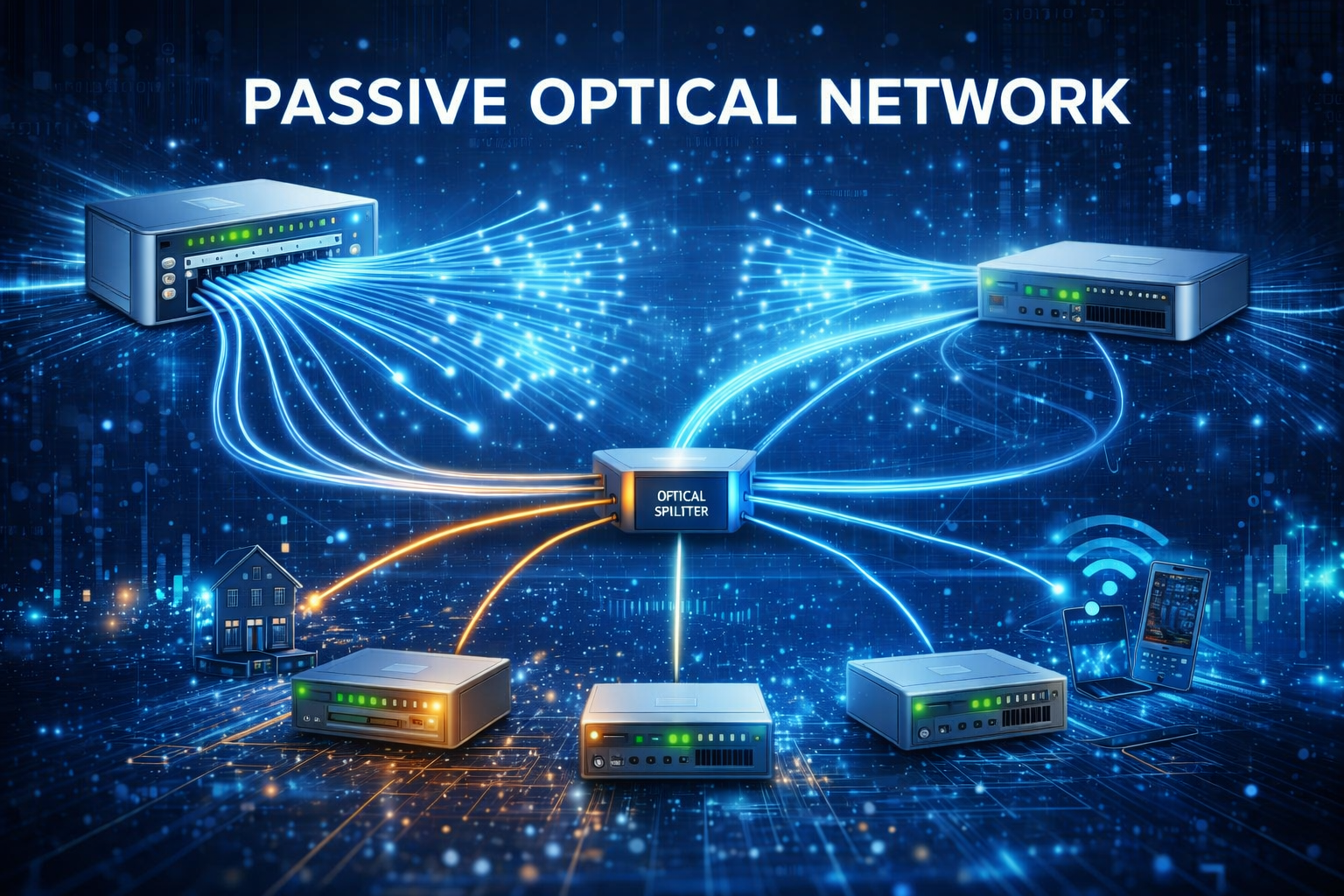
A passive optical network (PON) is a fiber-optic telecommunications technology that uses passive optical splitters to deliver internet connectivity from a central service provider to multiple end users. The word “passive” refers to the absence of powered electronic components between the provider’s central office and the subscriber.
In traditional networks, multiple active devices such as switches or amplifiers are required to distribute signals. However, PON networks rely on optical fiber cables and passive splitters, which significantly simplify the infrastructure.
This architecture allows a single optical fiber to serve multiple users simultaneously. As a result, it is highly efficient and widely used in modern fiber broadband networks.
Key Characteristics of passive optical network
-
Uses fiber optic cables for data transmission
-
Requires no powered equipment in the distribution network
-
Supports high bandwidth and long-distance communication
-
Reduces operational and maintenance costs
Because of these advantages, PON technology has become the preferred solution for high-speed internet deployment worldwide.
How Passive Optical Networks Work
The working principle of a Passive Optical Network involves distributing optical signals from a central office to multiple users through passive optical splitters.
The system typically consists of three main elements:
-
Optical Line Terminal (OLT)
-
Optical Distribution Network (ODN)
-
Optical Network Terminal (ONT)
These components work together to deliver high-speed data, voice, and video services.
Downstream Data Transmission
In downstream communication, data travels from the service provider to multiple users. The Optical Line Terminal sends optical signals through a fiber cable to passive splitters located within the distribution network.
The splitter then divides the signal among several subscribers. Each user receives the data intended for them via their Optical Network Terminal (ONT) installed at their premises.
Upstream Data Transmission
In upstream communication, data travels from the user back to the service provider. To prevent signal collisions, each ONT transmits data in assigned time slots using a technique called Time Division Multiple Access (TDMA).
This method ensures efficient communication and maintains high network performance.
Components of a Passive Optical Network
Understanding the key components of a PON system helps clarify how this technology delivers high-speed connectivity.
Optical Line Terminal (OLT)
The OLT is located at the service provider’s central office. It acts as the main control unit that manages data transmission between the provider’s network and the subscribers.
Key functions include:
-
Converting electrical signals to optical signals
-
Managing bandwidth allocation
-
Controlling upstream and downstream traffic
The OLT plays a crucial role in maintaining efficient network communication.
Optical Splitters
Optical splitters are passive devices that divide one optical signal into multiple signals. They allow a single fiber connection to serve multiple customers.
Common splitter ratios include:
| Split Ratio | Number of Users |
|---|---|
| 1:8 | 8 users |
| 1:16 | 16 users |
| 1:32 | 32 users |
| 1:64 | 64 users |
Because splitters require no electrical power, they significantly reduce energy consumption and infrastructure costs.
Optical Network Terminal (ONT)
The ONT is installed at the user’s location, such as a home or office. It converts the optical signal received through the fiber cable into electrical signals that devices like computers, routers, and televisions can use.
This device essentially acts as the interface between the fiber network and the user’s local network.
Types of Passive Optical Networks
Several variations of PON technology exist, each designed to support different bandwidth requirements.
GPON (Gigabit Passive Optical Network)
GPON is one of the most widely used PON standards. It supports high data rates and is commonly used in fiber-to-the-home (FTTH) networks.
Key features include:
-
Up to 2.5 Gbps downstream speed
-
Efficient bandwidth allocation
-
Support for multiple services such as internet, voice, and IPTV
Because of its efficiency and scalability, GPON remains a popular choice among telecom operators.
XG-PON and XGS-PON
Next-generation PON technologies such as XG-PON and XGS-PON offer significantly higher speeds compared to traditional GPON networks.
These advanced systems provide:
-
10 Gbps data speeds
-
Improved network capacity
-
Support for growing bandwidth demands
They are especially useful for supporting 5G networks, cloud computing, and smart city infrastructure.
Benefits of Passive Optical Networks
Passive optical networks offer several advantages over traditional broadband technologies.
Cost Efficiency
Since PON networks use passive components instead of active electronic devices, they require less power and maintenance. This reduces operational expenses for service providers.
High-Speed Connectivity
Fiber optic cables enable extremely high data speeds compared to copper-based systems like DSL or cable internet.
Scalability
PON networks can easily support additional users by adding new splitters without major infrastructure changes.
Reliability
Because passive components have fewer failure points, the network becomes more stable and reliable.
These advantages make passive optical networking technology an ideal solution for modern high-speed communication networks.
Applications of Passive Optical Networks
Passive optical networks are widely used across multiple sectors due to their high efficiency and performance.
Common applications include:
-
Fiber-to-the-Home (FTTH) broadband services
-
Enterprise and business connectivity
-
Smart city infrastructure
-
5G mobile backhaul networks
-
Educational and healthcare networks
As digital transformation continues, the demand for reliable fiber networks powered by passive optical network technology is expected to grow rapidly.
Conclusion
Passive Optical Network technology has revolutionized modern telecommunications by enabling high-speed, reliable, and cost-effective fiber broadband services. By using passive components like optical splitters and fiber cables, passive optical network simplify infrastructure while delivering exceptional performance.
Furthermore, advancements such as GPON, XG-PON, and XGS-PON are helping telecom providers meet the increasing demand for faster internet and greater bandwidth. As a result, passive optical networking is becoming a key component of next-generation digital infrastructure.






Post Comment