Alhambra Night Tour Attendance Revenue: The Quiet Economics of After-Dark Heritage
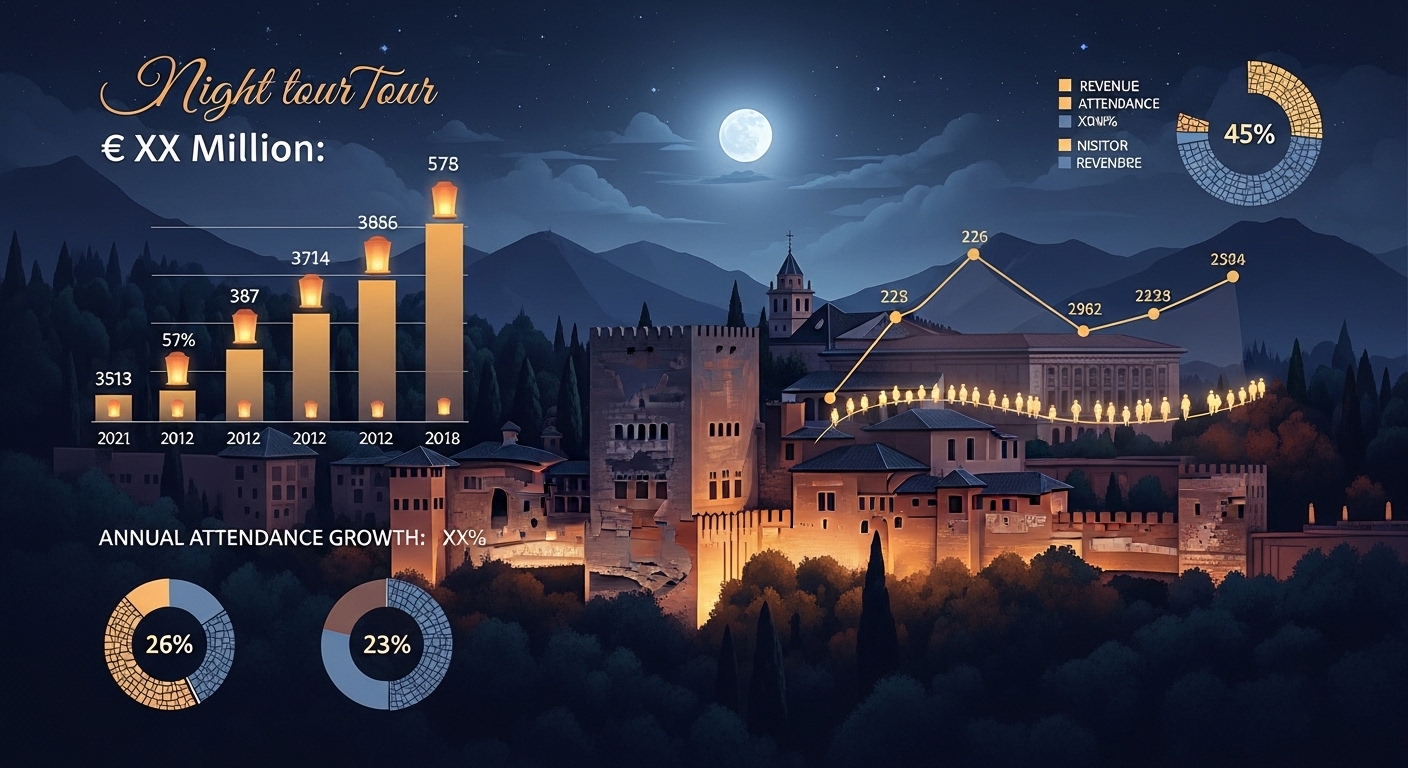
On a warm evening in Granada, as the sun slips behind the Sierra Nevada mountains, a different kind of visitor begins to arrive at the gates of the Alhambra Night Tour Attendance Revenue. The daytime crowds tour buses, school groups, and hurried itineraries have thinned. In their place comes a slower, more deliberate rhythm: couples, photographers, and travelers seeking something less transactional and more atmospheric. Lantern-lit pathways, hushed courtyards, and the soft echo of footsteps against ancient stone redefine the experience.
This shift from day to night is more than aesthetic. It represents a carefully engineered economic layer one where Alhambra night tour attendance revenue has emerged as a sophisticated model for balancing cultural preservation with financial sustainability. Beneath the romance of illuminated palaces lies a data-driven strategy that entrepreneurs and operators in tourism increasingly study with interest.
The Dual Economy of Day and Night
At its core, the Alhambra operates two parallel visitor economies. The daytime experience is built for scale: high throughput,
Alhambra Night Tour Attendance Revenue:
time slots, and predictable demand curves. Night tours, by contrast, are designed for scarcity and differentiation.
Attendance for night visits is deliberately capped far below daytime levels. This creates exclusivity, allowing the site to charge premium ticket prices while maintaining the integrity of the monument. From a revenue standpoint, this is not about volume it’s about yield per visitor.
For operators, this distinction is critical. The same physical asset the Alhambra generates two entirely different financial behaviors depending on how time is segmented and packaged. Night tours often command significantly higher per-ticket revenue, even if total attendance remains a fraction of daytime numbers.
Why Night Tours Command Higher Value
The pricing power behind night tours isn’t accidental. It’s rooted in perceived value. Visitors don’t simply buy access; they buy atmosphere.
Under carefully designed lighting, spaces like the Nasrid Palaces transform into something closer to theater than architecture. Shadows deepen geometric patterns, water reflections intensify symmetry, and silence becomes part of the experience.
From a business perspective, this is experiential layering. The product is enhanced without fundamentally altering the asset. No new construction is needed; instead, lighting design, timed entry, and narrative framing elevate perceived worth.
This approach mirrors strategies seen in premium entertainment Zoe Giordano Harrelson: Growing Up Between Privacy and Public Life and hospitality sectors. Limited availability plus heightened emotional engagement equals stronger pricing elasticity. Visitors are less price-sensitive because the experience feels unique and non-replicable.
Attendance Patterns: Scarcity as Strategy
Night tour attendance is intentionally constrained, often operating under stricter capacity limits than daytime visits. While this reduces total visitor numbers, it increases operational control and preserves the site’s ambiance.
From a revenue standpoint, the equation becomes:
Lower attendance × higher ticket price × premium experience = optimized revenue per visitor
This model also smooths demand across the day. By extending visiting hours into the evening, the Alhambra reduces daytime congestion while unlocking additional revenue streams. It’s a classic example of time-based capacity optimization a concept widely applied in airlines, hotels, and digital platforms.
Interestingly, night tours tend to attract a different demographic. Visitors are often more engaged, willing to spend more, and less rushed. This has downstream effects on ancillary revenue, including guided tours, photography services, and nearby hospitality businesses in Granada.
A Snapshot of Revenue Dynamics
To better understand how night tours contribute to overall performance, consider a simplified comparison:
| Metric | Daytime Tours | Night Tours |
|---|---|---|
| Average Attendance per Slot | High | Low to Moderate |
| Ticket Price | Standard | Premium |
| Visitor Experience | High traffic, structured | Intimate, atmospheric |
| Revenue per Visitor | Moderate | High |
| Operational Complexity | High (crowd management) | Moderate (lighting, security) |
| Contribution to Brand Value | Strong | Exceptional |
This table highlights a key insight: night tours are less about maximizing footfall and more about maximizing impact—both financially and experientially.
Operational Costs Behind the Glow
While night tours generate premium revenue, they also come with unique costs. Lighting infrastructure, security staffing, and preservation considerations all require careful planning.
Unlike daytime operations, where natural Stock Market Pessimist: Understanding the Mindset Behind Bearish Investinglight does the heavy lifting, night tours depend on curated illumination. This isn’t just about visibility; it’s about storytelling. Lighting designers must balance aesthetics with conservation, ensuring that sensitive surfaces are not damaged over time.
Security also becomes more nuanced. Lower visibility and smaller groups demand a different approach to monitoring and crowd control. Staff training, surveillance systems, and emergency preparedness all contribute to operational expenses.
Yet, despite these costs, the margins often remain attractive. The premium pricing structure typically offsets additional expenditures, especially when attendance is managed efficiently.
The Branding Effect: Beyond Direct Revenue
One of the most overlooked aspects of Alhambra night tour attendance revenue is its indirect impact on brand equity.
Night tours elevate the Alhambra from a historical site to a cultural experience. This distinction matters. Visitors who attend night tours are more likely to share their experiences—through photography, social media, and word-of-mouth. The visual drama of illuminated courtyards and reflective pools translates exceptionally well in digital formats.
In effect, night tours function as both a revenue stream and a marketing engine. They generate content that reinforces the Alhambra’s global reputation, attracting future visitors who may initially discover the site through these evocative nighttime images.
For entrepreneurs, this is a powerful lesson: premium experiences often double as brand amplifiers.
Lessons for Tourism and Experience Design
The success of night tours at the Alhambra offers broader insights for anyone operating in tourism, heritage management, or experiential business models.
First, time is an underutilized asset. By rethinking how hours are structured, organizations can unlock new revenue streams without expanding physical capacity.
Second, scarcity can be more profitable than scale. Limiting access, when paired with enhanced value, creates a willingness to pay that mass-market offerings rarely achieve.
Third, storytelling matters. The transformation of the Alhambra at night isn’t just visual—it’s narrative. Visitors feel as though they are stepping into a different era, a quieter and more reflective version of history.
Finally, preservation and profitability are not mutually exclusive. When managed carefully, premium experiences can generate the funds needed to maintain and protect cultural assets.
Challenges and Constraints
Despite its success, the night tour model is not without limitations. Regulatory frameworks, conservation requirements, and community considerations all shape how the program operates.
Local authorities must balance tourism revenue with the needs of residents in Granada. Noise, traffic, and environmental impact are ongoing concerns. Additionally, the fragile nature of the Alhambra itself imposes strict limits on how many visitors can be accommodated, regardless of demand.
There’s also the risk of over-commercialization. If night tours become too frequent or lose their sense of exclusivity, the very factors that justify premium pricing could erode.
Maintaining equilibrium between access and preservation, revenue and authenticity is an ongoing challenge.
The Future of Night Tourism
Looking ahead, the concept of night-based tourism is gaining traction globally. From museums offering after-hours access to national parks experimenting with stargazing programs, the idea of extending experiences into the evening is becoming increasingly mainstream.
The Alhambra remains a benchmark in this space. Its approach demonstrates how cultural heritage sites can innovate without compromising integrity. By carefully controlling attendance, enhancing the visitor experience, and aligning pricing with perceived value, it has created a model that is both sustainable and scalable in principle.
For entrepreneurs and operators, the takeaway is clear: the next frontier of growth may not lie in building more, but in reimagining what already exists especially when the sun goes down.
Closing Reflection
As the final visitors exit the Alhambra’s gates and the lights dim across its courtyards, what remains is more than a successful revenue strategy. It’s a reminder that economics, when thoughtfully applied, can deepen rather than diminish cultural experiences.
The story of Alhambra night tour attendance revenue is ultimately about transformation of space, of time, and of value. It shows how a centuries-old monument can continue to evolve, not by changing what it is, but by changing how it is experienced





Post Comment